

Planned service scope
Depot-level means exterior wash / car wash, interior clean, light maintenance (such as windshield washer top-up and similar minor items), and charging.
Depot · Regional facility infrastructure
Hamilton Cybercabs is not only a planned Cybercab fleet — we aim to build a large, partner-capable megawatt-class depot-level service facility to support it, alongside other regional partners as may be needed. Depot-level means exterior wash / car wash, interior clean, light maintenance (such as windshield washer top-up and similar minor items), and charging. This is not a Tesla repair facility: vehicle repairs remain Tesla's responsibility, although that boundary could change later. Electrical capacity is the planning unit; square footage is secondary.
Visual concept dossier
A visual study of the proposed Hamilton operating environment: the Cormorant Road site plan, seasonal charging yards, and the physical wash → interior clean flow. These are illustrative concepts only — not a built facility and not Tesla-affiliated.
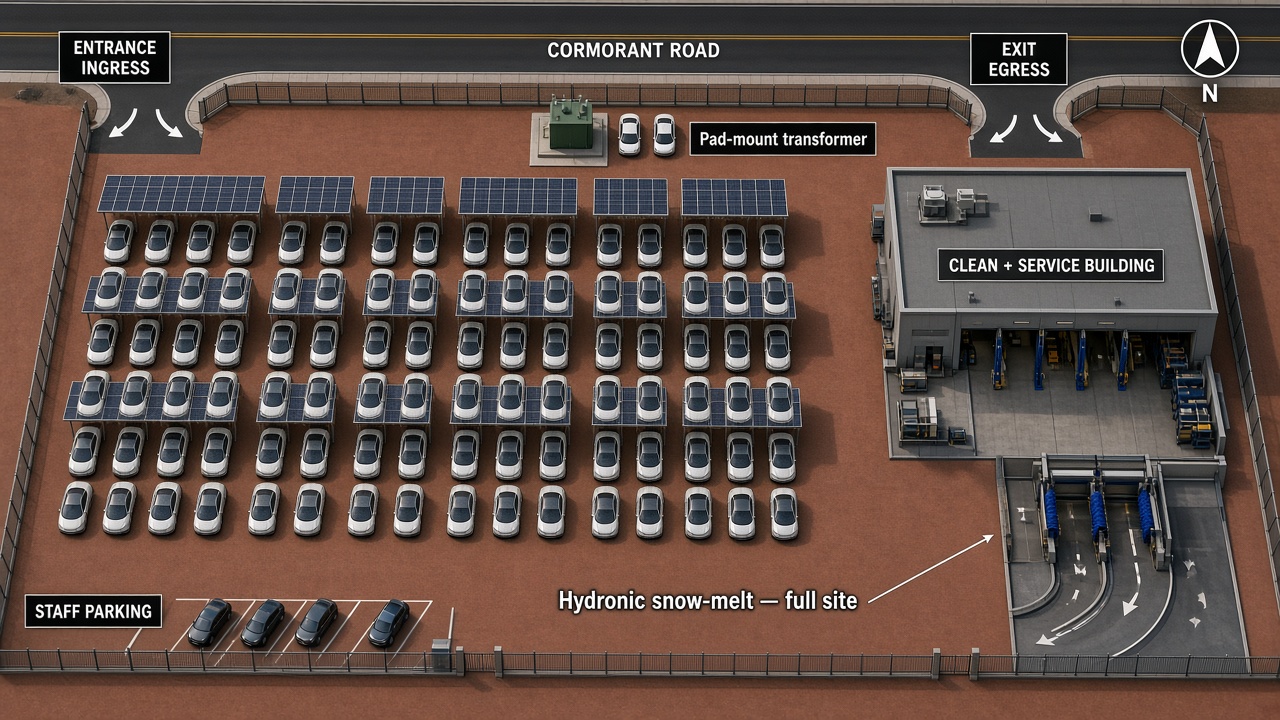
Illustrative concept layout on Cormorant Road with entrance and exit curb cuts, pad-mount transformer near the frontage, up to ~200 charging stalls (induction-primary), and full-site hydronic snow-melt — not a built facility and not Tesla-affiliated.
Hamilton Cybercabs concept render (illustrative)
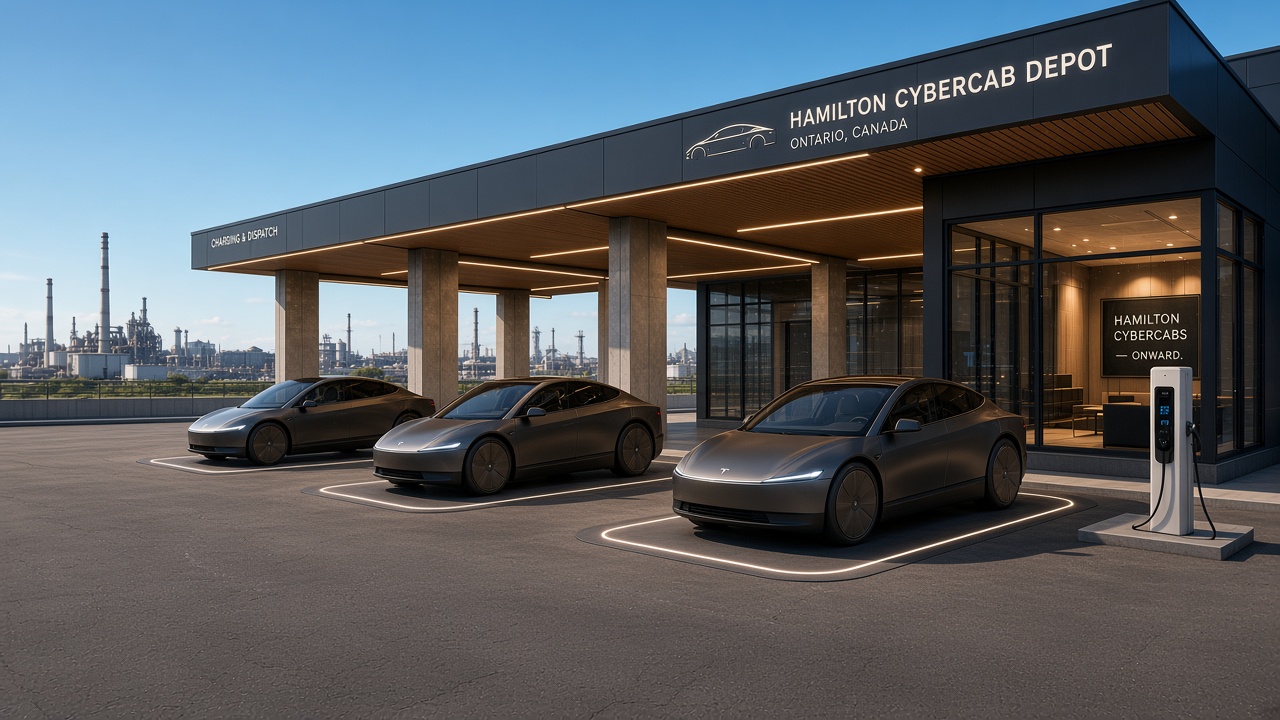
Illustrative concept render showing the summer charging yard with induction-primary charging and plug-in secondary capability — not a built facility and not Tesla-affiliated.
Hamilton Cybercabs concept render (illustrative)
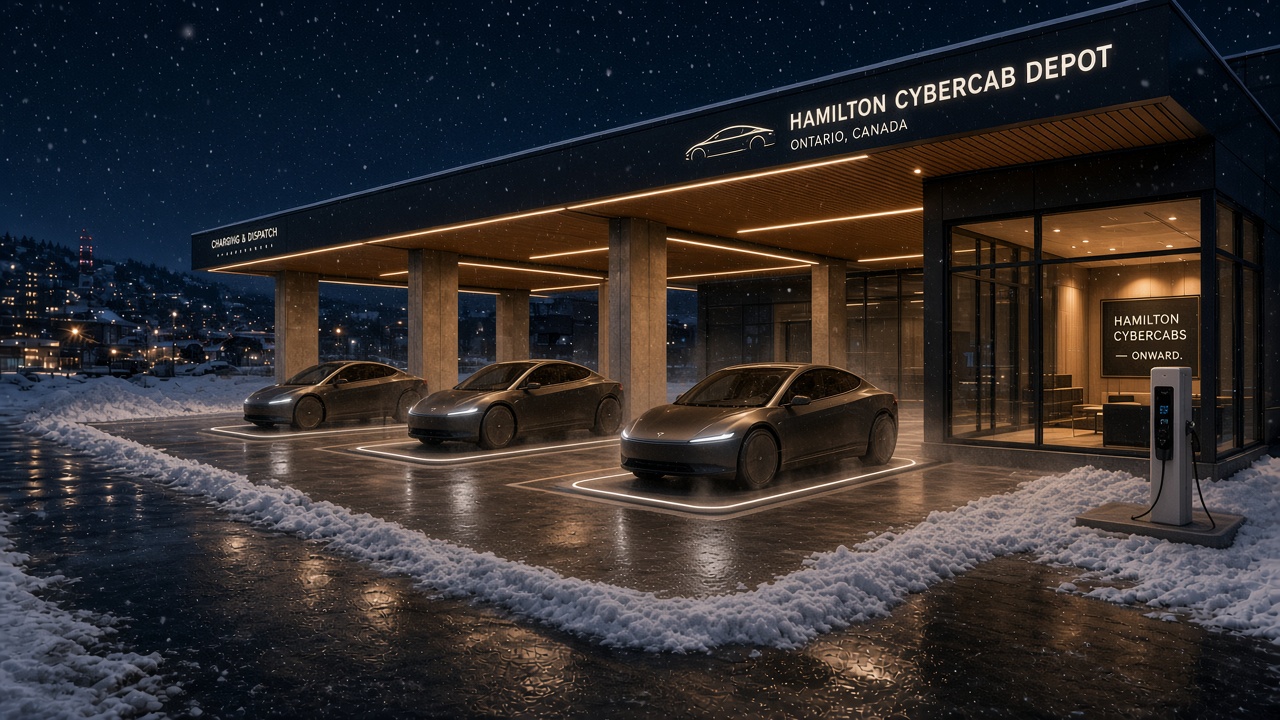
Illustrative concept render of winter operations with hydronic snow-melt across site pavement and induction-primary charging — not a built facility and not Tesla-affiliated.
Hamilton Cybercabs concept render (illustrative)
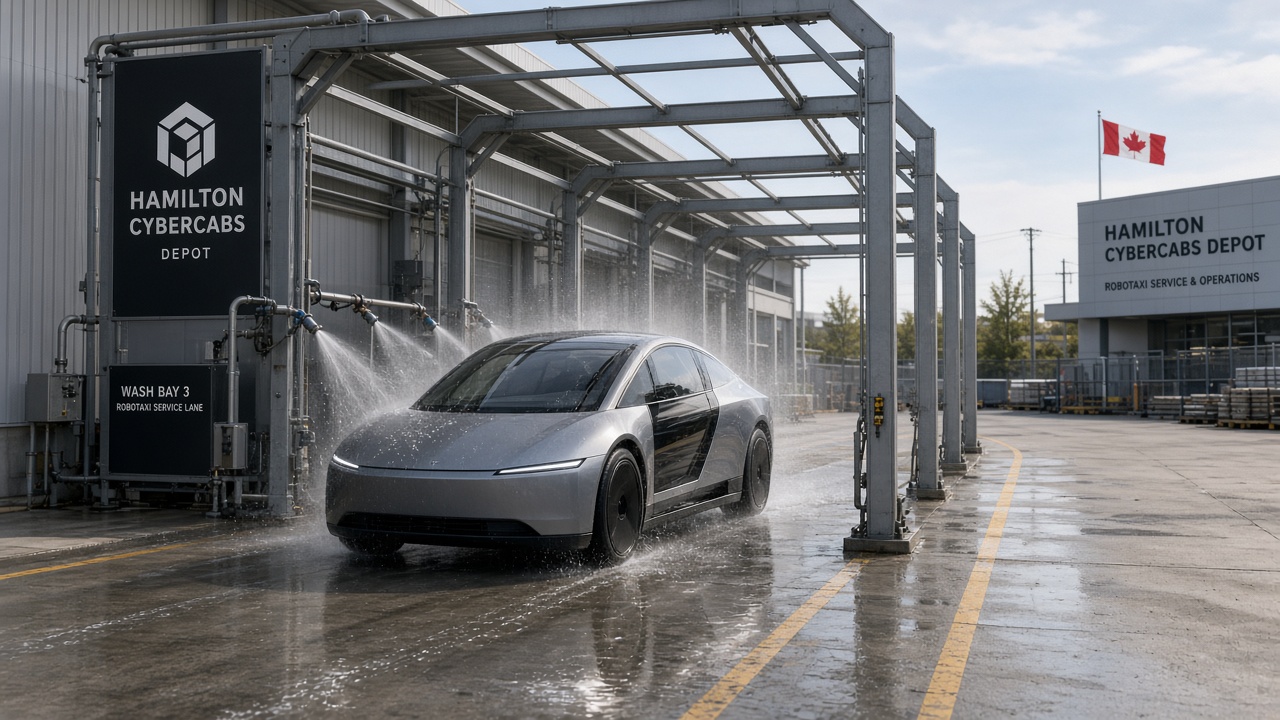
Illustrative concept render of the drive-through exterior wash, the first stage of a planned wash → interior clean flow — not a built facility and not Tesla-affiliated.
Hamilton Cybercabs concept render (illustrative)
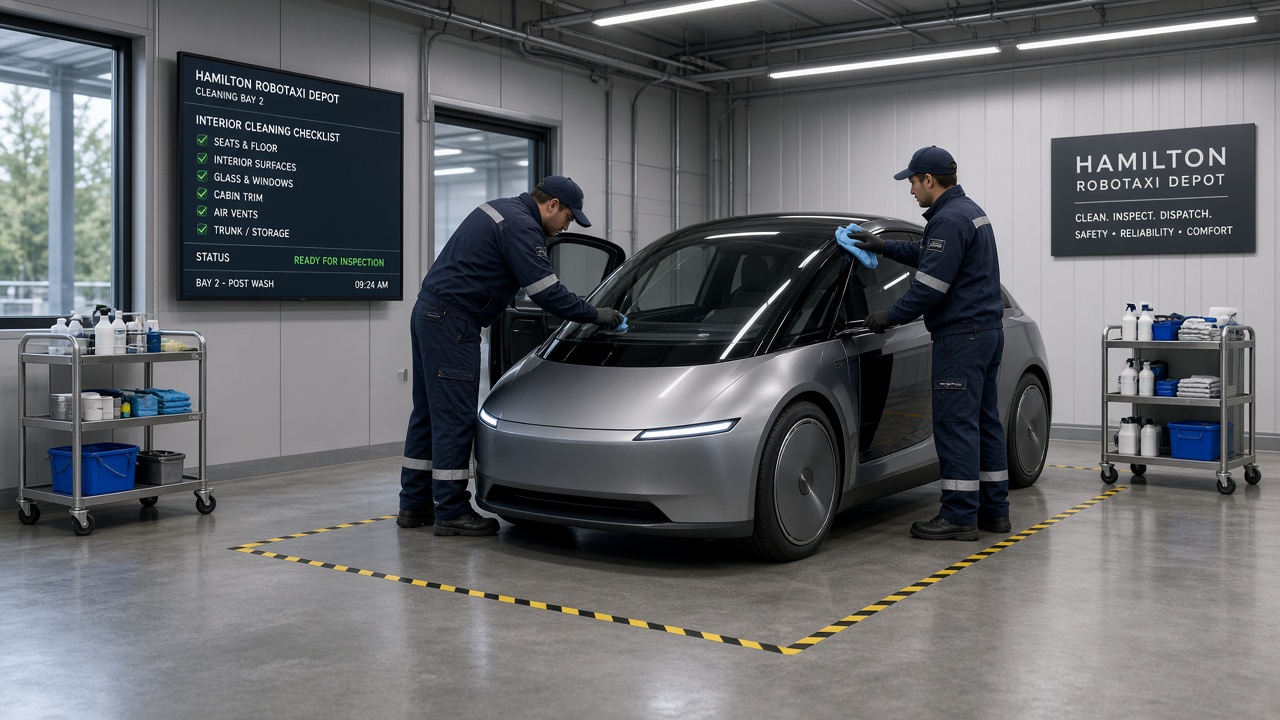
Illustrative concept render of the personnel interior-cleaning bay after exterior wash, before charge / maintain / release — not a built facility and not Tesla-affiliated.
Hamilton Cybercabs concept render (illustrative)
Service scope · Clearly bounded
Depot-level means exterior wash / car wash, interior clean, light maintenance (such as windshield washer top-up and similar minor items), and charging.
This is not a Tesla repair facility. Vehicle repairs remain Tesla's responsibility; that boundary could change later.
Utilization depends on the hub
Autonomous kilometres only pay when vehicles cycle quickly through charge, clean, maintain, and release. A purpose-built depot keeps utilization high and downtime short — for our own fleet and, where partnerships make sense, as a regional service point for other operators in the Golden Horseshoe.
Night and off-peak charging windows, turnaround cleaning, and maintenance buffers determine how many revenue kilometres a cab can deliver.
Designed as regional depot-level infrastructure — not sole-operator-only by intent. Other regional partners may share or use capacity as arrangements allow.
Hamilton-rooted ops own readiness on the ground: power interconnection, zoning, workflows, and day-to-day facility discipline in the Greater Hamilton / Golden Horseshoe.
Planning unit = electrical capacity
Beyond operating a fleet, we aim to build a large, partner-capable megawatt-class depot-level service facility — alongside other regional partners as may be needed — to serve as a service point for Cybercabs in Hamilton and the Golden Horseshoe. Depot-level means exterior wash / car wash, interior clean, light maintenance (such as windshield washer top-up and similar minor items), and charging; it is not a Tesla repair facility, and vehicle repairs remain Tesla's responsibility (that boundary could change later). Planning is power-first: up to a 3 MW service (≈3000 A at 600 V 3-phase), generally the largest typical interconnection before a utility substation is required. That power envelope is illustratively sized for ~100 Cybercabs on a ~6-hour charge window, with an operating flow of drive-through exterior wash bay → interior cleaning by personnel → charge / maintain / release. Summer and winter are both first-class operating modes; hydronic snow melting is planned across the full site pavement for Canadian winter operations. Concept site planning also contemplates up to ~200 charging stalls, a pad-mount transformer near the road frontage, and dedicated entrance/exit onto Cormorant Road. Site selection is underway. Square footage is secondary to power, circulation, and workflow design.
Target electrical service
Up to 3 MW
≈3,000 A at 600 V 3-phase
Illustrative fleet for power
~100 Cybercabs
~6-hour charge-window planning
Workflows
charge · clean · maintain · release
Short turnaround window
Status
Site selection
Hamilton area
The operating flow is deliberately physical and repeatable: a drive-through exterior wash bay, followed by interior cleaning by personnel, light maintenance, then charge / release. Short turnaround is the goal — the depot is a cycle, not a parking lot. Light maintenance means items such as windshield washer top-up and similar minor items; it does not include vehicle repairs.
Step 1
Vehicles enter a purpose-built exterior wash lane before moving inside.
Step 2
People reset and inspect the cabin so every vehicle is passenger-ready.
Step 3
The fleet receives light maintenance only—such as a windshield washer top-up and similar minor items—then is charged and released into service. Vehicle repairs remain Tesla's responsibility.
Designed for Canadian conditions
The facility plan is not seasonal by accident. It must keep the fleet moving through warm-weather utilization peaks and Canadian winter conditions, with circulation, cleaning, charging, and release designed into both modes.
High-throughput wash, interior reset, charging, and maintenance cycles support daily regional utilization.
Hydronic snow melting is planned across the full site pavement to keep circulation, parking, and charging usable through Canadian winter conditions.
Hydronic snow melting across the full site pavement (circulation, parking, and charging) is a core Canada-winter operating requirement.
Power ↔ fleet sketch
Up to 3 MW is illustratively framed for roughly 100 Cybercabs on a ~6-hour charge window — a planning envelope, not a committed order or utility agreement.
Supporting pack math (illustrative; not a Tesla claim): pack ≈47.6–48 kWh; ≈53 kWh AC wall energy for a full charge. Real interconnection, charger mix, and duty cycle will refine this.
Footprint (secondary)
Building size follows workflow and power — not the other way around. Early sketches have referenced roughly 2,500–4,000 sq.ft. as an optional secondary note only; capacity and process design lead.
Non-affiliated reference
Reported Las Vegas Cybercab hub patterns (wash / service / fleet turnaround) inform how a Hamilton regional depot might stage charge · clean · maintain · release. Useful as a workflow and facility-pattern cue only.
Non-affiliated planning reference only — inspired by reported patterns at Tesla Center Mohawk (Las Vegas). Hamilton Cybercabs is not affiliated with Tesla’s Mohawk facility.
Any reference to Tesla Center Mohawk (Las Vegas) or similar third-party facilities is a non-affiliated planning / pattern reference only. Hamilton Cybercabs is an independent Hamilton concept and is not affiliated with, endorsed by, or a partner of Tesla’s Mohawk site.
Site selection is underway in the Hamilton area. Zoning, utility interconnection, and municipal permitting remain gating items — not assumed solved.
Cybercab availability, pricing, and commercial robotaxi operation are contingent on Tesla's Cybercab / robotaxi program, regulatory approvals in Ontario and Canada, insurance, and local operating conditions. There is no assurance vehicles will be delivered or that autonomous passenger service will be permitted on the contemplated timeline.
Capital · Separate infrastructure track
Depot infrastructure is a separate infrastructure build-out. This page describes operating capacity and workflow intent only.